

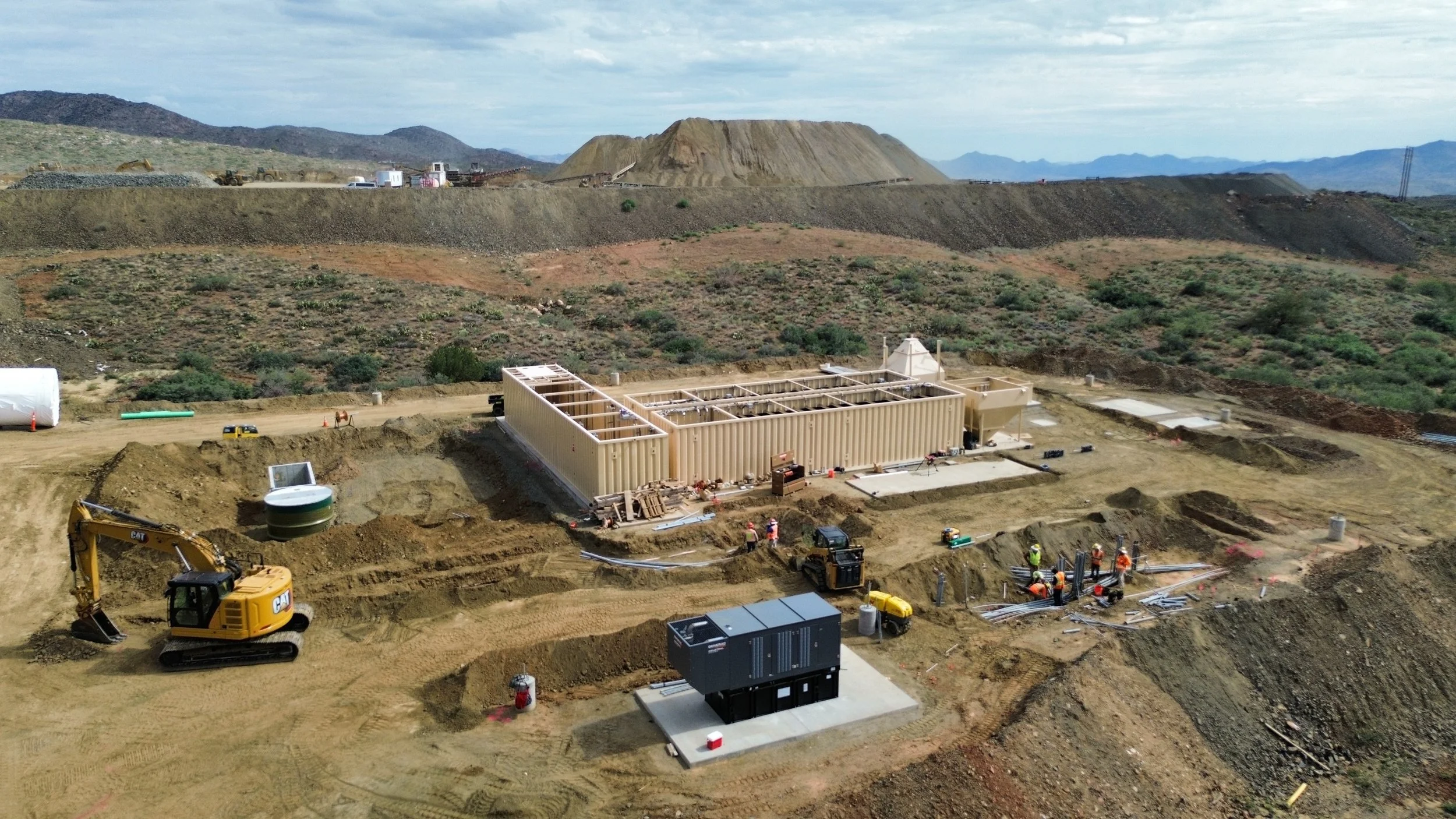
The Problem
Every legal challenge that has halted DRI construction traces to the same root cause: infrastructure inadequacy. The Maryland TRO was granted because 1,500 detainees would produce over 187,000 GPD of wastewater, exceeding municipal sewer capacity. PA DEP has issued administrative orders blocking water and sewer permits at Hamburg and Tremont. Community opposition — bipartisan, including from Republican legislators — centers on the same argument: these facilities will overwhelm local infrastructure.
The Administration Needs An Engineered Solution, Not A Political One
On March 5, 2026, PA DEP issued five administrative orders blocking all water and sewer service at both Pennsylvania sites. These orders document infrastructure gaps that make the current municipal-connected approach impossible.
Tremont, PA
Bed Count7,500
Acreage173.32
Water System Cap330K GPD
DHS Water Need936K GPD
Sewer Cap6,000 GPD
DHS Sewer Need450K–1M GPD
StatusPermits blocked
Hamburg, PA
Bed Count1,500
Acreage62
Water System Cap12,240 GPD
DHS Water Need191,800 GPD
Sewer Cap8,000 GPD
DHS Sewer Need112.5K–225K GPD
StatusPermits blocked
Tremont — SCMA & Township Orders
No water service except fire protection. No sewer above 6,000 GPD. No holding tanks, retaining tanks, privies, or chemical toilets. 48-hour notification required for any water use request. Township must revise sewage plan before issuing any permits.
Hamburg — DHS & Township Orders
No well operations without DEP permits. No bulk water hauling. No occupancy without Township sewage compliance. Written infrastructure plan required within 20 days. No sewer above 8,000 GPD. DEP cited federal sovereign immunity waiver — DHS cannot override state environmental requirements.
Our Answer: Closed-Loop Infrastructure
A self-contained facility that produces its own water, treats its own wastewater, and recycles it back into service.
On-site water production — Permitted production wells with treatment to PA Safe Drinking Water Act standards and 2-day reserve storage. Replaces all municipal water dependency.
Containerized MBR wastewater treatment — Membrane Bioreactor systems treat all facility wastewater on-site. 75% recovery rate. Effluent exceeds PA discharge standards by 10–30x. Zero demand on municipal sewer.
Closed-loop grey water recycling — Treated effluent is recycled into the facility's non-potable water supply. Fresh water production drops by 64%. All effluent consumed. No discharge. No NPDES permit. No state permitting lever.
Self-contained power generation (optional) — N+1 generator arrays for full grid independence. UPS for medical, security, and life safety systems.
0
Municipal water demand
0
Municipal sewer demand
0
Discharge permits required
0
State permitting leverage
$72–81M
Year 1 Infrastructure
(both sites, water/WW)
(both sites, water/WW)
9,000
Total beds unlocked
(Hamburg + Tremont)
(Hamburg + Tremont)
0.17%
Of DRI program budget
($45B+ authority)
($45B+ authority)
Bottom Line
The DEP orders documented every infrastructure deficiency in forensic detail — which is exactly the record needed to demonstrate that our approach addresses each one. A facility that produces its own water, treats its own wastewater, and recycles it back into service has zero impact on municipal infrastructure, zero discharge requiring a state permit, and zero leverage for a hostile governor to exploit. When DHS returns to Pennsylvania, this is the answer.
MBR Treatment System
Membrane Bioreactor Technology — How It Works, Why It Works
Our wastewater treatment system is built around packaged Membrane Bioreactor (MBR) technology — a proven, commercially mature platform widely deployed at military installations, remote federal facilities, and large-scale worker encampments worldwide. MBR combines conventional biological treatment (activated sludge) with membrane filtration, producing effluent quality that exceeds Pennsylvania discharge standards by 10–30x and is suitable for direct non-potable reuse.
MBR systems are containerized in standard ISO shipping containers or skid-mounted modular units for rapid deployment. All units ship pre-plumbed, pre-wired, and pre-tested for immediate commissioning upon delivery. Remote monitoring and automated controls allow 24/7 operational oversight with minimal on-site operator labor.
Three-Stage Treatment Process
1
Equalization
Wastewater is collected in a basin during high-flow hours and gradually released at a uniform rate during low-flow hours. Eliminates hydraulic shock to the biological process and ensures consistent treatment performance regardless of population activity patterns.
2
Anoxic BNR
Nitrate-rich water from the aerobic zone is recirculated to an oxygen-free anoxic zone. Denitrifying bacteria convert nitrates into nitrogen gas, released harmlessly to atmosphere. Critical for meeting Pennsylvania watershed-specific nitrogen limits and producing reuse-quality effluent.
3
MBR Filtration + UV
Submerged flat-plate membranes (0.08 micron pore size) physically separate treated water from biomass. Transmembrane pressure created by gravity — no permeate pumps required. Diffusers scour membranes while providing oxygen to aerobic bacteria. UV disinfection on permeate.
▸
▸
▸
75%
Treated effluent recovered → recycled to facility
25%
Biosolids → dewatered & hauled off-site
Effluent Quality vs. Pennsylvania Standards
| Parameter | MBR Effluent | PA Standard | Margin |
|---|---|---|---|
| BOD | < 3 mg/L | 25 mg/L | 8× better |
| TSS | < 1 mg/L | 30 mg/L | 30× better |
| Turbidity | < 0.2 NTU | — | Reuse quality |
| Total Nitrogen | < 3 mg/L | Varies | Enhanced BNR |
| Ammonia (NH₃) | < 1 mg/L | Varies | Near-complete |
| Total Phosphorus | < 0.05 mg/L | Varies | Chemical addition |
| Fecal Coliforms | < 2/100 mL | 200/100 mL | 100× better |
Hamburg Configuration
250K GPD
3 operational + 1 standby (N+1) containerized modules. ~83K GPD each. Footprint: 5,000–10,000 SF within 62 acres.
Tremont Configuration
1.0 MGD
4-module OXIGEST MBR field-erected array with TITAN MEM-BOX external membrane tanks. ~250K GPD/module. 20,000–40,000 SF within 173 acres.
Membrane Technology
Flat-Plate
S&L submerged PVDF+PET flat-plate membranes. Lower fouling rate, no backwash required, semi-annual CIP cleaning, 10-year warranty available.
Equipment Vendor Partner
Smith & Loveless Inc.
Lenexa, Kansas · 75+ years of wastewater treatment experience
TITAN MBR™
OXIGEST® MBR
TITAN MEM-BOX™
FAST®
QUICKSMART™ PLC
RemoteView™ Cloud
References & Source Documentation
EPA Membrane Bioreactor Fact Sheet
EPA 832-F-07-014 · Comprehensive overview of MBR technology, design considerations, performance data, and cost benchmarks for municipal wastewater treatment.
epa.gov → PDF ↗
EPA Water Reuse Guidelines
Federal guidance on treated wastewater reuse for non-potable applications including grey water systems, landscape irrigation, and industrial process water.
epa.gov/waterreuse ↗
40 CFR Part 503 — Biosolids Standards
Federal standards for biosolids use, disposal, and management. Governs our sludge dewatering, handling, and off-site hauling operations.
epa.gov/biosolids ↗
Smith & Loveless — Treatment Systems
TITAN MBR, OXIGEST MBR, TITAN MEM-BOX, and FAST product lines. Factory-built MBR systems for municipal, military/defense, and industrial applications.
smithandloveless.com ↗
42 U.S.C. § 300j-6(a) — Federal SDWA Compliance
Federal agencies subject to state water quality requirements. Sovereign immunity expressly waived for administrative orders. Cited by PA DEP in Hamburg order to DHS.
law.cornell.edu ↗
33 U.S.C. § 1323(a) — Federal CWA Compliance
Clean Water Act waiver of sovereign immunity. Federal facilities must comply with state and local water pollution control requirements.
law.cornell.edu ↗